Jozef Rivest
PhD Student, Political Science & Scientific Computing
University of Michigan, Ann Arbor
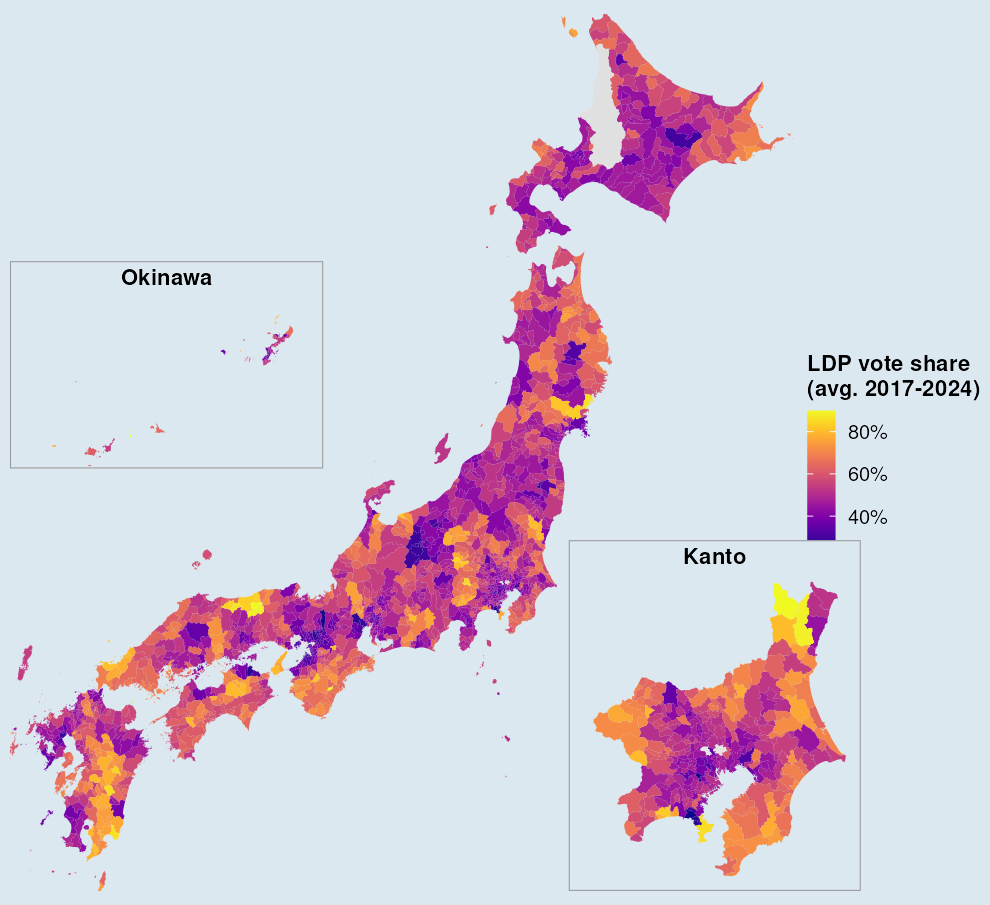

Welcome! I am a Ph.D. student at the University of Michigan. My research is situated at the intersection of public opinion, comparative politics, and international relations, with a regional focus on East Asia and the Indo-Pacific. I am currently interested in public good provisions, spatial analysis, public opinion, voting behavior, bayesian analysis, and multilevel models. I currently study how infrastructure and the built environment shape political engagement. My research are anchored in Japan, but extend to South Korea, Taiwan, and Southeast Asia.
I also study research methods, with a primary focus on measurement and scaling techniques. I have published several papers on the use of AI in the social sciences, examining its accuracy in predicting and classifying political phenomena.
This is a picture of me.

Go blue!
jrivest@umich.edu
Publications
-
"Prompting the Machine: Introducing an LLM Data Extraction Method for Social Scientists"
Social Science Computer Review, 2025
doi:10.1177/08944393251344865 ↗ -
"Ain't no party like a GPT party: assessing OpenAI's GPT political alignment classification capabilities"
Journal of Information Technology & Politics, 2025, 1–13
doi:10.1080/19331681.2024.2444587 ↗
Working Papers
-
"Unshakable Pacifism? Psychometric Approach to Japan's Contemporary Pacifist and Antimilitarist Attitudes"
Research on Japanese pacifism and antimilitarism has long relied on survey items to compare attitudes across demographic groups and over time. However, these comparisons rest on three untested assumptions: (1) that pacifism/antimilitarism is unidimensional, (2) that all items contribute equally to measuring these attitudes, and (3) that items measure the same constructs across groups (measurement invariance). Using data from the 2022 UTokyo-Asahi Survey (N=1,014), I use a psychometric approach to evaluate these assumptions. Results reveal a two-dimensional structure distinguishing domestic capabilities from international dimensions. Measurement invariance tests yield a differentiated picture: the scale achieves full strong invariance across age cohorts, providing a valid basis for cross-generational comparisons, while weak invariance marginally fails to reach significance across gender (p = 0.090), though item intercepts remain fully equivalent. Critically, these results—combined with the dimensional structure and differential item functioning analyses—demonstrate that single-item inferences about pacifist and antimilitarist attitudes are doubly unreliable: they capture only one dimension of a two-dimensional construct and may be biased for specific groups. A properly specified multi-item scale, validated through measurement invariance testing, offers a more robust foundation for inference. I argue that future research must account for this multidimensional structure and establish measurement equivalence before making cross-group comparisons. These findings establish methodological foundations for longitudinal research examining temporal changes in these attitudes.
Works in Progress
-
"Missing the Train: Shinkansen Bypass and Political Alienation in Japan"
-
"Permanent or Temporary? Understanding Japanese Preferences Toward Immigration"
-
"Public Support for Emerging Military Technology Development in Middle Powers"